Mutual Funds in Summary
Mutual funds pool money from investors and deploy it into a diversified portfolio across equity, debt, money markets—or a mix. A professional fund manager runs the portfolio and the fund publishes a daily NAV (net asset value), so performance is transparent and easy to track.
Why investors use mutual funds
- Diversification: Lowers single-stock/issuer risk by spreading across many securities and sectors.
- Professional management: Research-driven security selection, rebalancing and risk control.
- Choice of objectives: Equity (growth), debt (income/stability), hybrid (balanced), and more.
- Transparency: Daily NAV, factsheets, holdings and expense ratio disclosures.
- Convenience: SIP/STP/SWP, online KYC, and consolidated tracking.
Returns are market-linked and not guaranteed. Expenses and taxes (TER, loads, capital gains) apply.
A quick example (illustrative)
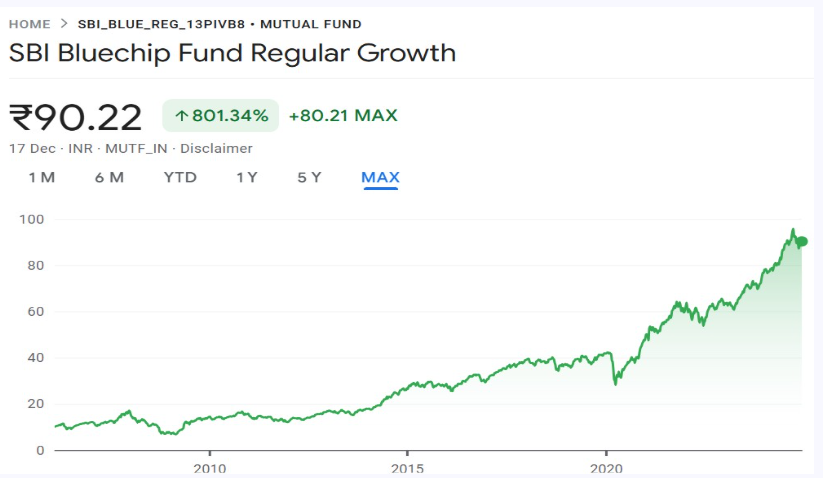
Suppose a large-cap equity fund’s NAV rose from ₹17.01 (18-Jan-2013) to ₹81.05 (29-Apr-2024). That’s about 4.76× over ~11 years, roughly ≈15% annualised (CAGR) before costs and taxes.
What to remember
- Match fund choice to your goal, horizon, and risk comfort.
- Prefer process, consistency and cost over chasing last year’s winners.
- Use SIPs for discipline; review annually—not daily.
Frequently Asked Questions
- What is a mutual fund and how does it work?
A pooled vehicle that invests across securities; a manager runs the portfolio and NAV is published daily. - How do mutual funds generate returns?
From NAV appreciation and, where applicable, dividends/interest from the underlying holdings. - Are mutual funds safe?
They carry market/interest-rate risk. Diversification helps but does not eliminate loss. Pick funds to match risk and horizon. - What is NAV?
The per-unit value of the fund after valuing holdings and expenses; typically published daily. - What’s the difference between SIP and lump sum?
SIP invests periodically to smooth volatility; lump sum invests all at once and is more timing-sensitive. - What costs apply?
The TER (Total Expense Ratio) is charged within NAV. Some funds have exit loads for early redemption. - How are mutual fund returns taxed in India?
Dividends are usually taxed at your slab. Capital gains depend on fund category and holding period; confirm current rules. - How do I choose a fund?
Align to goal/horizon, check process and asset allocation, review costs and track record across cycles. - How long should I invest?
Multi-year for equity funds; shorter horizons for debt funds depending on rate risk. Review annually. - How do I redeem and what is exit load?
Submit redemption via AMC/platform; units sell at next applicable NAV. Exit load may apply within a set period—check scheme docs.
Education only. Product features and taxation can change—confirm current rules with your broker/platform and tax advisor.